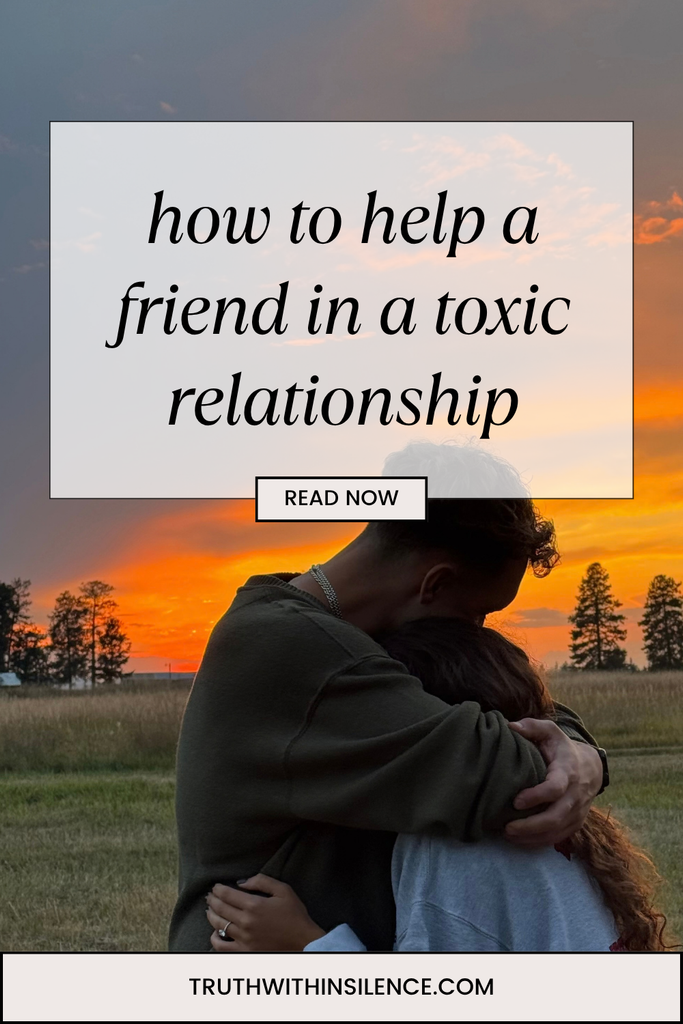
How To Help A Friend In A Toxic Relationship

Several years ago, when I was in an abusive and toxic relationship, I was in complete denial.
My intuition knew something was off for a long time, but my head refused to accept reality. I kept holding onto the false hope that things would somehow change for the better, or go back to how it was in the beginning. As time slowly passed, I realized that I was holding onto something that was never real to begin with.
For the majority of the relationship, I didn’t tell anybody the truth about what was happening. I held in my secrets for as long as I could because I was ashamed that I was allowing somebody to treat me that poorly for so long. Not only that, but I was also ashamed of their actions. I couldn’t justify letting anybody else see what was actually going on behind closed doors. I was trying to learn how to separate the lies from the truth and find the strength to carry on through it all.
Once I could no longer hide the extent of the emotional and physical harm I was experiencing, I started confiding in my mom. Tears streamed down my face when every Google search confirmed what she told me: I was in an abusive and toxic relationship.
Somehow, physically reading those words solidified what I already knew deep down. After leaving that relationship, I knew part of my healing process would be opening up to the people who loved me unconditionally.
The problem with being in an abusive or toxic relationship is feeling a strong desire to protect the other person. I remember when I first started sharing bits and pieces with my friends, they were in complete shock. I knew it was hard for them not only to process what I was telling them, but also learn how they could be there for me when I felt like I was just starting to learn how to breathe again.
It’s hard to process the weight and depths of a situation until we’re in it ourselves. Since October is Domestic Violence Awareness Month, and as somebody who lived through it firsthand, here’s how you can help if your friend is in an abusive or toxic relationship:
Express How You Feel But Be Patient
Our gut feeling never lies to us. We can typically sense and feel when something is off with a friend and their relationship. In my particular situation, I was cut off from a lot of my friends. I wasn’t “allowed” to talk or spend time with them. This wasn’t explicitly said, but if I did, repercussions would soon follow such as being accused of putting other people above our relationship, receiving the silent treatment or having to reassure/explain myself over and over.
I never dealt with this type of relationship before, but I found myself tiptoeing around my ex’s feelings because in my eyes, I was being respectful to what he “needed”. If you sense something is off with your friend, express how you feel but be patient throughout the process if they aren’t receptive or ready to hear what you have to say.
I found myself getting defensive when my friends or even family members would raise concerns or voice their opinions about red flags they were seeing because I kept telling myself that it wasn’t like that. Mentally, it’s a lot for somebody in an abusive or toxic relationship to process what they’re going through, and even if you have the right intent, they can’t always see as clearly as you can when they’re in the middle of it all.
Looking back, there’s obviously so much that I wish I could’ve or would’ve done differently, including opening up to my friends sooner. Express concerns for your friend, but be open to how they’re feeling even if you can’t or don’t necessarily agree with it. Always be honest, but respect that your friend is trying to process heavy emotions and confusion that they’ve most likely never experienced before. They’ll confide in you when they’re ready.
Listen Without Judgment
When your friend is ready to open up, listen compassionately and without judgment. I was at complete rock bottom by the time I was at the end of that relationship, I honestly don’t think I could’ve sunk any lower.
What pulled me out was surrounding myself with the people who loved me unconditionally. The ones who would always listen to me without judgment when I was finally ready to open up, and the ones that I knew I could trust more than anything.
None of my friends ever made me feel less for any of my decisions, even when they couldn’t necessarily understand them. We never know what somebody else is carrying. It can make all the difference in the world listening to somebody with compassion and just simply being there for them when they’re trying to process the weight of what they went through.
I never needed somebody to say the right words at the right time, because I knew it wouldn’t erase the pain. But I did need the reassurance that the people I opened up to would embrace me with love, compassion, and understanding.
Ask How You Can Be Supportive
Sometimes it’s as simple as asking your friend how you can be supportive to them. They might need different things at different times. One day they may need to vent and cry, and another they might need to completely take their mind off the situation and not talk about it at all.
Sometimes I needed to tell the story one more time, and other times I needed to sit with a friend who I knew would make me laugh. The first time I ever spoke everything out loud, I sat in my bedroom with some of my closest friends and talked about it for hours. It was the release I never knew I needed, because there was so much I left hidden and unsaid.
I kept myself busy rotating between work and my social life, and I never stopped. The second I slowed down and I was alone, the memories would replay themselves in my head over and over, like a nightmare I couldn’t wake up from. But my friends and my support system were what saved me in the end. Ask your friend how you can be supportive and most importantly, show up because it can make all the difference. People will always remember who was there, especially when they need it the most.
Reassure Them It’s Not Their Fault
Whether it was talking to ‘somebody I shouldn’t’ or not showing enough affection, I was always accused of being in the wrong. I kept feeling like I deserved how I was being treated because of my “mistakes”.
The most important thing I learned throughout the entire process was having a deep understanding and knowing that the abuse was never my fault. Abuse is never okay, and there’s never an excuse for it. When you’re repeatedly put down or being told you aren’t enough, you essentially start to believe it.
And that’s exactly what happened in my situation. There was so much blame I left at my feet and felt responsible for because my abuser convinced me that I caused him to be abusive. Abusers and narcissists are master manipulators, often skewing your reality to fit their perception. It’s hard to shift and alter your mindset when you’re in constant fight or flight mode, even if deep down your friend knows what they’re being convinced of is false.
I never needed the perfect words, just the reassurance that I wasn’t the cause or reason for what I was experiencing. Reassure your friend that it’s not their fault and it was never their fault. Abuse is a choice, and there’s nothing they did to ever deserve how they’re being treated.
Related posts you might like:
- 7 Signs Your Relationship Is Toxic
- What I Learned From Being In An Abusive Relationship
- 5 Subtle Red Flags You Should Never Ignore
Encourage Them To Process Through All Their Emotions
There were days when I was in that abusive and toxic relationship that I didn’t know if I’d ever be able to let go and move forward. When we go through something so traumatic, it takes so much time to heal and process everything that happened.
After I left that relationship, it took me so long to learn how to process what I was feeling and what I went through. It’s almost like I buried my emotions and the trauma of what happened for so long that I didn’t realize how deeply embedded the roots were in me. I went through a lot of stages, similar to the stages of grief. I was angry, sad, depressed, but eventually the bigger part of me finally felt free. As time went on and the days started to pass, each brick slowly lifted one by one until the intense pain finally subsided once and for all.
Your friend might still experience times of complete shock and disbelief as they unravel everything they went through and relearn who they are. Be a shoulder for them to lean on, and remind them that it’s okay if they experience a lot of ups and downs as they find their new sense of normalcy.
It’s okay if some days feel calmer while others they’re simply trying to keep their head above water. They might not know how to sit with the heavy parts they can’t deal with yet, but having that support is all they’ll need.
Remind Your Friend Of All Their Amazing Qualities
It’s hard knowing how to approach your friend after they were in an abusive or toxic relationship. However, one of the most important things you can do is remind them of all their amazing qualities and how unconditionally loved they are. I was constantly told otherwise in the relationship I was in, and I struggled with knowing how to separate lies from the truth.
When I first opened up to my friends, it could be as simple as a text telling me how much I mean to them or sharing qualities of the person they knew me to be, and it would mean more than anything because I felt the sincerity behind it. Even though I knew I deserved love that didn’t hurt and that I did matter, somehow actually hearing those words made all the difference in my healing process moving forward.
Always remind your friend that everything will be okay, even when it feels the farthest from it. Processing trauma is complex, and it’s also okay to seek professional help if needed. Reassure your friend that they always deserve to be happy, healthy, and most importantly safe. And there’s always, always hope for a better future.
If you or somebody you know is experiencing abuse, know that there are resources available to help. Visit the National Domestic Violence Hotline website or contact them 24/7 at 1-800-799-7233 (SAFE).





Excellent information in this article on helping our friends. All too often it is easier to ignore the issue – but the tips included in this article are important to show our friends we do care and support them.
Thank you so much! & so true. It’s so important to remind our friends that they’re not alone in what they’re facing, rather than looking the other way. It can make all the difference!
Love this! One of my best friends was in a toxic relationship and it was so hard to help her see it and support her. Thanks for sharing such great information!
Thank you!! It’s especially hard when you’re on the outside looking in & can see all the things they can’t at the time. But all we can do is support our friends the best of our ability & hope that they see the truth eventually! Thanks for reading ❤️
Such an important topic, thank you for sharing! I’ve been the friend trying to help a friend in a toxic relationship before, and I struggled with how to help. This is very straightforward and helpful. Thank you for sharing your story.
Thank you so much! Learning how to navigate supporting a friend in a toxic relationship is so difficult, especially when you want to help but aren’t sure how to. But I think sometimes even just being there for them to lean helps so much, even if you don’t always know what to say necessarily. I’m glad it was helpful!! ❤️
This is such good advice. Sadly, one of my friends died because she would not leave the toxic relationship. Get away if you feel unsafe!
Thank you! I am so sorry to hear about the loss of your friend. That’s heartbreaking & it’s so hard to watch somebody you deeply care about struggle in a toxic relationship. I agree with you, our gut feeling will never lie to us, even when sometimes we’d rather look the other way and ignore it because we’re hoping it’s wrong.
I really resonate with this! Supporting a friend through a toxic relationship can be incredibly challenging, but your article offers such helpful guidance. Thanks for sharing!
I’m so glad it resonated with you!! Yes, it absolutely can be, especially when you want to help but aren’t sure of how. I appreciate you reading!
Love this post! I thought it was very real and relatable!
Aw good I’m so glad! Thank you so much!
It’s important to speak out when your relationship is going downward. And sometimes the best advice would come from your parents. Great article!
SO important! I think it’s hard when you’re in that situation, and you want to ignore it or hope that it’ll suddenly get better. I agree with you, usually they know us the best more than anyone else & always know how to steer us right. Thank you so much!
This is such important information, I really appreciate you sharing. I have had a few friends who have been in toxic relationships, and it can be hard to know what to do! Posts like this help. Thanks!
Yes it can be so difficult knowing what to say, and how to approach the situation when you’re on the other side. I’m so glad you found it helpful!