Reminders For Overcoming Burnout

While I love the start of a new year because it feels like a blank slate, it can also come with the added pressure and high expectations to keep doing “more”.
We start setting new goals, find a renewed sense of motivation, and even try changing our habits to push toward a better version of who we currently are. But when we keep piling one thing on top of another without giving ourselves a break, it can lead to burnout quicker than we realize.
Burnout happens when we become overstimulated, exhausted and mentally drained. It can take a toll on our physical and mental health, causing us to feel unproductive or as if we have nothing left to give. While stress can be a result of burnout, it can also happen because of life circumstances or feeling like we aren’t doing enough.
If you’re struggling with the effects of burnout, here are 4 reminders to help you manage and overcome it:
1. Your Mental Health Means More Than A To-Do List
The problem with setting high expectations and not meeting them on the timeline we think we should, is that it can make us feel further behind than we actually are.
During times when I’ve experienced immense stress, it eventually led to the point of complete burnout because I was focusing too much on where I wasn’t, rather than realizing there was purpose in where I was.
Even if we aren’t accomplishing everything we want to do or a fraction of it, a to-do list should never be put above our mental and physical health. December was a heavy month for me. While I had a lot of content planned, life also happened in the midst of it. Taking a break taught me that pausing doesn’t mean failure. Focusing on what would make me feel the best mentally rather than pushing myself to an unrealistic limit was way more important than checking off boxes on a list.
Reflecting on where we are can help us gain a clear understanding and perspective on whether we’re burned out, the reasons behind it, and what we can do to improve it moving forward. Sometimes we aren’t even aware of how we’re feeling until we take the time to self-reflect and remind ourselves that putting our health first is the most important.
A few important questions to help with self-reflection include:
- How do I currently feel emotionally and physically? Is there an area I need to focus on more than others?
- What is causing me the most stress? What small changes can I make to reduce it, or let go of feelings of inadequacy?
- Are there any patterns or triggers I notice that might be leading to repeated feelings of burnout?

2. Your Thoughts Aren’t Facts
One of the biggest things I’ve learned about burnout is that just because we think something, it doesn’t necessarily mean that it’s true.
While we should set goals, expectations and improve our intentions or habits, they also shouldn’t come at the cost of sacrificing our mental health. The bigger part of me felt like if I wasn’t accomplishing everything I set out to do, or things went different from the way I expected, I was somehow falling short in all areas. Which couldn’t have been further from the truth.
Our best might not look like 100 percent each day. Some days we can only give 10 or 20 percent. But as long as we’re giving what we’re capable of, then it’ll always be more than enough.
Nothing was more important to me this last month than being there for my mom, especially after she had a pretty bad health scare. My priority became less about making sure I had all my content out on the days I planned on, and more about finding out what was needed in each moment.
We aren’t giving ourselves a fair chance when we keep piling pressure on top of expectations, especially when things aren’t turning out the way we thought they would. But our thoughts aren’t facts. Trust that even if you aren’t matched up to the timeline in your head, it doesn’t mean you’re failing or falling behind. You’re exactly where you need to be, especially when you’re doing the best you can with what you have.
Related posts you might like:
- 12 Winter Self-Care Ideas To Help You Feel Your Best
- 5 Helpful Reminders When You’re Running On Empty
- The Hard Truth About Healing And Growth
3. Rest Is Productive Too
We aren’t only successful when we’re “on” all the time, or constantly pushing ourselves to the limit.
One of the reasons my body repeatedly experienced burnout was from trying to do everything at once to get ahead, which essentially put me further behind. I wasn’t allowing my body and mind to take the break it needed to recharge and reset, leading to my mind being on overdrive. It not only affected mentally, but physically. I noticed that I started losing sleep because I kept thinking of the ‘next’ thing I had to do.
When we exceed the limits of what we’re capable of, it only leads to neglecting our needs. Instead of feeling guilt when I chose rest, I realized that rest is what pushed me to feel refreshed and renewed.
Making the promise to do something for myself, whether it was carving out time for self-care, getting a quick exercise in, or relaxing with a book, made all the difference in reversing the symptoms of burnout. I also started breaking my day into chunks, instead of fitting in as much work as I possibly could. These ‘little’ changes ended up completely transforming my days and weeks moving forward.
Taking the time to rest starts with deciding what you enjoy and making time for it. Maybe instead of reading a book, it’s doing a puzzle, or getting together with a friend. The reality is that there will always be something to do, but your physical and mental health suffers the most when you refuse to take the necessary time to recharge.
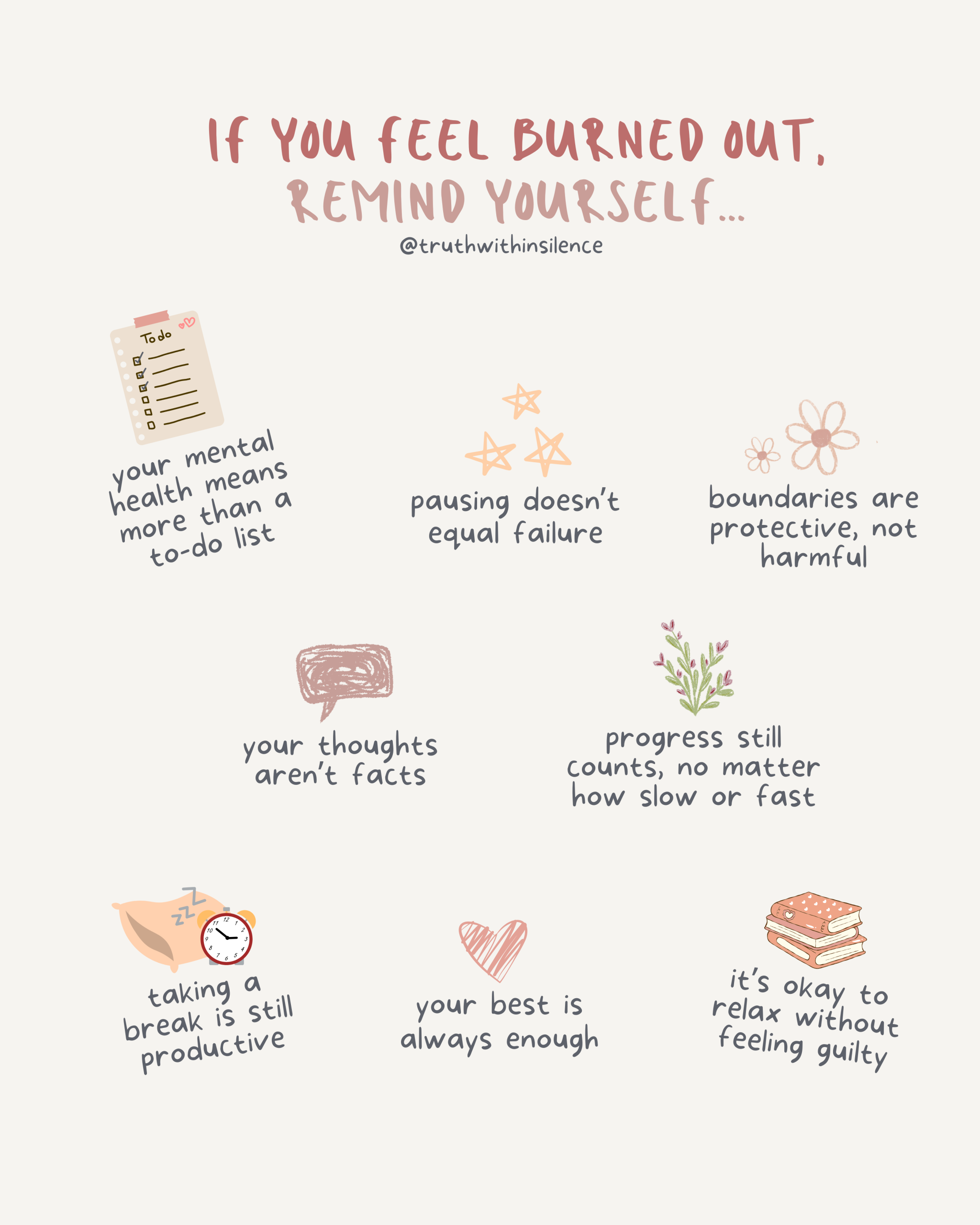
4. Boundaries Aren’t Harmful, They’re Protective
As a people-pleaser, boundaries are something I’ve struggled with throughout my entire life.
Whether you’re experiencing burnout because of work, relationships, or friendships that leave you feeling drained, one of the best ways to start healing is figuring out what healthy boundaries look like to you.
Start noticing what fulfills you, and what depletes your energy. I know that when I start feeling overstimulated, it’s likely because I overcommitted to obligations that I should’ve said no to in the first place.
Not everything needs a lengthy explanation attached to it, and you should never allow yourself to feel guilty when it comes to saying no to something that you don’t want to do or aren’t okay with. Boundaries aren’t there to harm others, they’re there to protect what’s most important to you.
Some helpful questions to ask yourself when it comes to setting boundaries:
- What fulfills me? What drains me?
- What boundaries should I start setting to protect my mental health?
- Where do I find myself overcommitting? How can I simplify my schedule?
- What’s something I need more or less of?
Boundaries aren’t always easy to establish, especially if you’re somebody who is used to saying ‘yes’ rather than ‘no’. But once you notice certain triggers or areas you can improve in, it’ll be a lot easier to maintain boundaries and stick by them. While it’s important to be there for others, it’s equally important to take care of yourself and what’s best for your own mental health.
Unraveling the effects of burnout might not happen immediately, but even taking small steps can help improve it in the long run. While we can’t prevent stressful situations from happening in our lives, as long as we’re doing our best, it’ll always be more than enough.