What I Learned From Being In An Abusive Relationship

10 years ago, when I was deep in an abusive relationship, I remember taking a picture of myself with the caption: “There are so many beautiful reasons to be happy”. My life felt far from happy, and I so badly wanted to believe in those words, for the slightest hope that there was some sincerity behind my smile.
I was finishing my junior year in college when my world came crashing down around me. I was dating somebody I felt like I shared an instant connection with: a mirror to what I desired and wanted out of a relationship. But as the months went on, I began to see the first glimpse of abuse. I started to realize that my ‘perfect’ relationship was nothing more than a figure of my imagination, something that was never real to begin with.
Before this relationship, I had never been put down, criticized, yelled at, or abused before. I heard about it happening to others, yet I could never understand the complexities of abuse. How could people stay, and why?
It wasn’t until I went through it myself that I was able to decipher through the never-ending layers of abuse, opening my eyes to a world that I never knew existed. As somebody who’s been through it, here are the truths I’ve learned from being in an abusive relationship:
Abusive Relationships Unravel Over Time
I think one of the most common misconceptions about abusive relationships is that they start out as abusive.
According to the DV Hotline, “The warning signs of abuse don’t always appear overnight and may emerge and intensify as the relationship grows.” An abusive person knows that they can’t show their true colors right away. If they were to reveal who they were at the beginning of a relationship, then they’d know that they have little chance of keeping their partner right where they want them.
Instead of waving around massive red flags, they’ll subtly show you who they are over time, without revealing too much at once. In the first incident when I saw a glimpse of abuse, I was called names for innocently responding to a guy friend who contacted me.
I remember waking up the next day, fully convinced that he’d realize it was a simple misunderstanding and would apologize for the unnecessary name-calling and aggressive behavior. But instead, the complete opposite happened. I’ll never forget the moment he turned to me and asked: “You’re going to apologize for what you did, right?”
I chalked it up to knowing he had a ‘bad past’ causing ‘insecurity’ and ‘trust issues’. Looking back, I realize that I wasn’t educated on the topic of abuse at all. I assumed that people always knew what they were getting into because the toxic signs would be obvious (controlling, jealousy, etc.). When, in fact, it’s usually the quite opposite. After that incident, it’s almost like the abuse remained dormant until he felt comfortable exposing the next layer that could no longer be hidden.
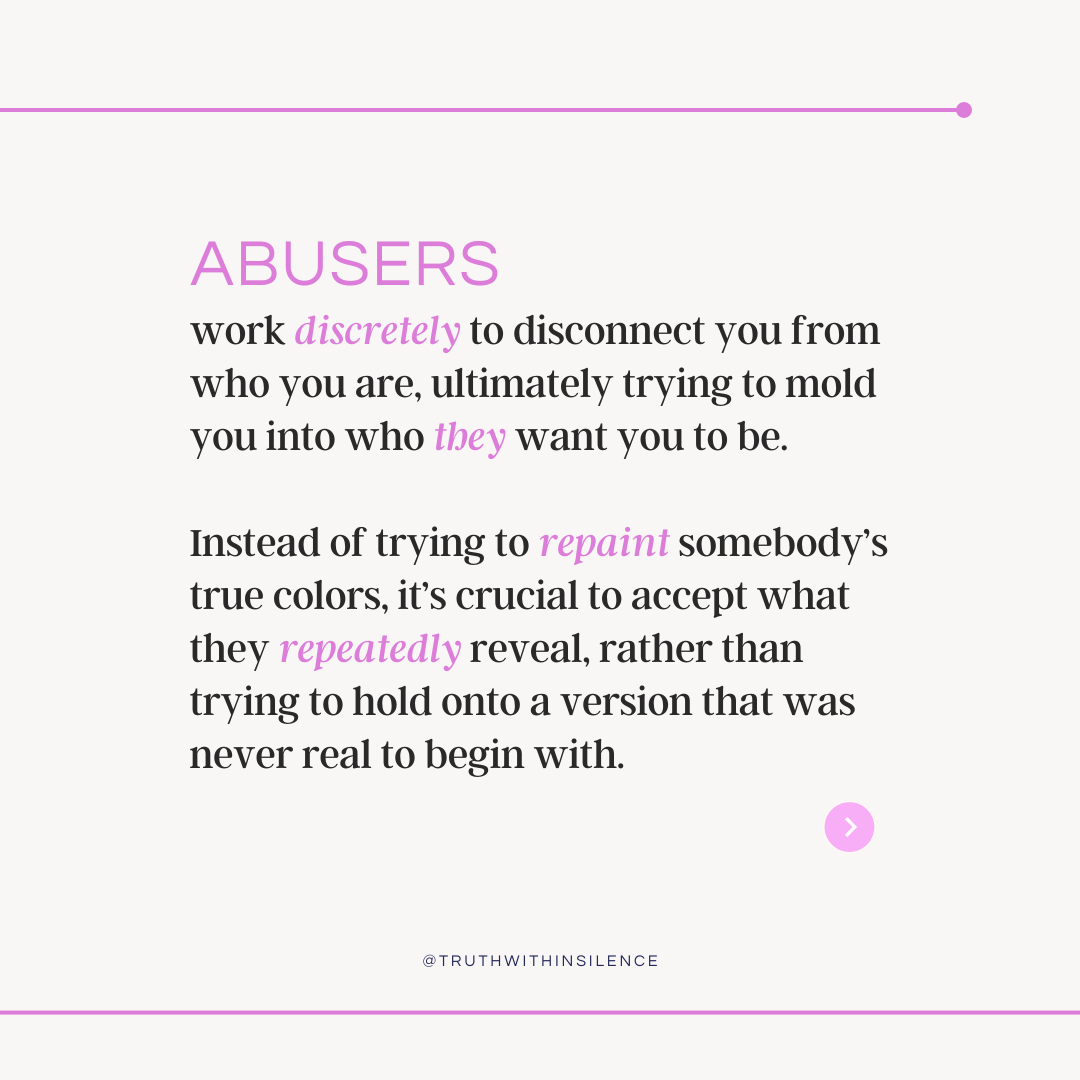
Instead of trying to repaint somebody’s true colors, we have to accept what they repeatedly show us, rather than holding onto the version that we wish was real. Abusive people work slowly and discretely to disconnect you from who you are, ultimately trying to mold you into who they want you to be.
Not All Abusive Relationships Follow The Same Pattern
For me, one of the hardest parts when I was learning about abusive relationships, was realizing that not all abusive relationships followed the same pattern.
When somebody first told me that I was in an abusive relationship, I remember hardly believing what I was reading after I spent countless hours googling phrases including: “Am I in an abusive relationship?”, “Signs of an abusive relationship” and “What to do if you’re in an abusive relationship”. Ironically, up until this point, I didn’t even connect the pieces that I was in an abusive relationship because in my eyes it didn’t follow the ‘typical’ signs of abuse—yet all the signs were there, I just couldn’t see them.
It’s hard to compare and contrast abusive relationships because it’s rare that two situations will ever mirror each other exactly. It’s more than just physical, abusive relationships can happen in several ways.
DV is,“a pattern of behaviors used by one partner to maintain power and control over another partner in an intimate relationship.” This can take many forms, and while not every relationship will follow the same pattern; the abusive person in the relationship will always repeat their pattern.
An abusive person works hard to cover the truth of who they are, and will go to the most extreme lengths to hide their toxicity and true colors. While it might take more than one incident to recognize the pattern, remember that patterns will always repeat themselves.
Related posts you might like:
- 5 Subtle Red Flags You Should Never Ignore
- Advice and Resources For Healing After Abuse
- Important Lessons I Learned From Dating A Narcissist
The Relationship Won’t Always Be Bad
I struggled with learning how to let go because my mind would repeatedly hold onto the ‘good’ moments, even if they were far and few between.
Toxic and abusive people are calculated to know exactly what they’re doing. The reason there’s a statistic that it takes an average of seven times to leave is because if there’s even a slight chance that they’ll think you could leave, they’ll do anything to drag you back in.
But here’s another truth about abusive relationships: the bad will always outweigh the good, and the bad will never actually get better. If anything, the relationship will continue to progressively get worse. I kept trying to hold onto the hope that the relationship would change or go back to the way it was, when reality and time proved that image was never real to begin with.
It’s something that becomes incomprehensible, especially when your mind tries to hold onto the person that you ‘think’ you know they are—outside of the bad times. Our brains tend to block off the trauma to protect us, but the real problem is that it can blur the line between suppressing memories and trying to learn how to dissociate from how bad the relationship actually is.
Abusive Relationships Can Cause You To Question Your Reality
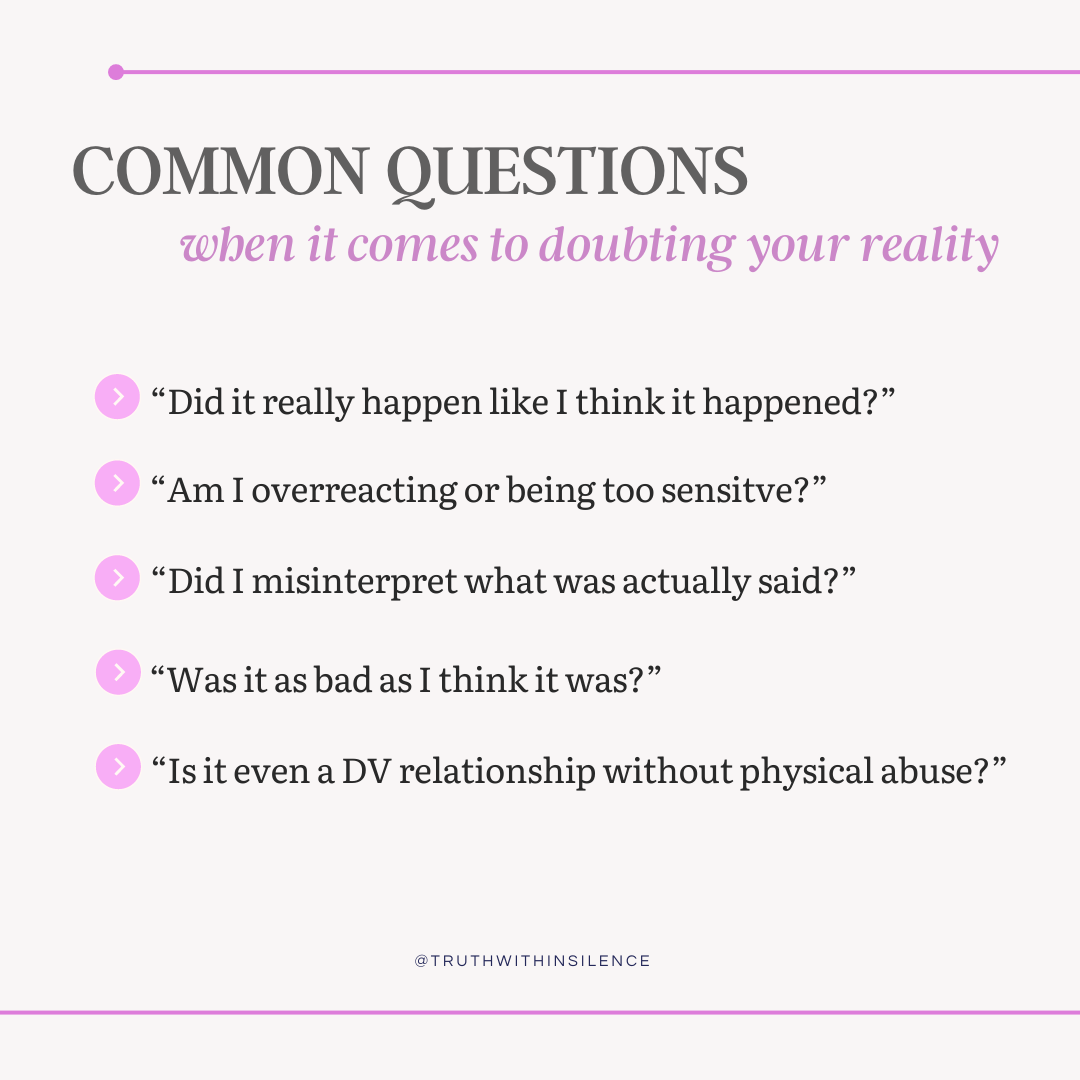
Common questions when it comes to second-guessing your reality include:
- Did it really happen like I think it happened?
- Am I overreacting or being too sensitive?
- Did I misinterpret what they said?
- Was it as bad as I remember it?
- Is it even a DV relationship without physical abuse?
It did happen like you thought it did, you aren’t overreacting, you didn’t misinterpret the situation, and even without physical v*olence, it’s still considered DV. This concept is called gaslighting, and before I was in an abusive relationship, I never heard or understood what the term was.
According to Verywell Mind, gaslighting is: “a form of manipulation that often occurs in abusive relationships. It’s a covert type of emotional abuse where the abuser misleads the target, creating a false narrative and making them question their judgments and reality.”
This type of manipulation can leave partners feeling disregarded, confused, inadequate, and doubting the truth of what actually happened. Reality becomes blurred, and you start to question the things that you know deep down happened. The truth is, it’s always as bad as you can remember it being, even though sometimes it can be hard to accept it when you’re trying to be convinced of the complete opposite.
Never second-guess or doubt your instincts and what you know to be true. If something feels off, it always is.
Abusive relationships can be physically, mentally, and psychologically draining. While there are a lot of layers to abuse, know that there is always healing and hope to be found for a better future, even when it feels the opposite. You always deserve to be in a relationship that makes you feel happy, loved, and most importantly, safe.
If you or somebody you know is experiencing abuse, know that there are resources available to help. Visit the National Domestic Violence Hotline website here or contact them 24/7 at 1-800-799-7233 (SAFE).